8 min read
Avionics repair pricing has a reputation for being opaque, and some of that reputation is earned. But most of the variation between quotes is not margin — it is scope. Two facilities quoting the same unit are frequently quoting different pieces of work, and the cheaper number is often the smaller job rather than the better deal.
This article does not publish prices, because a price without the unit, the fault and the condition in front of it would be meaningless. What it does is explain the structure, so you can read a quote properly.
What you are actually paying for
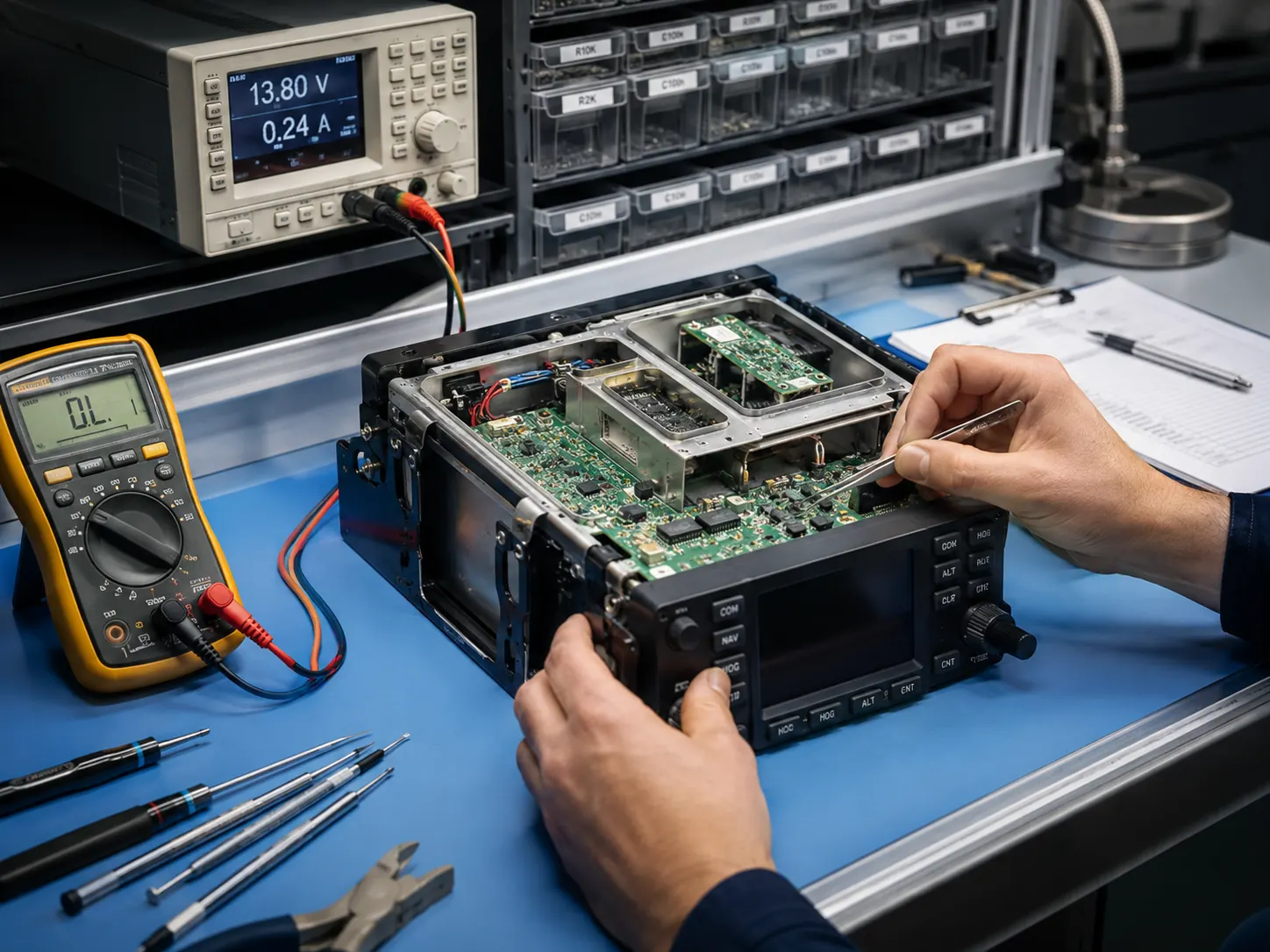
An avionics repair is five distinct pieces of work, and a quote may include all, some or one of them:
- Evaluation — incoming inspection, fault confirmation, and enough investigation to produce a quote.
- Teardown and diagnosis — opening the unit and isolating the failure to a component or assembly.
- Parts — the components replaced, which on obsolete equipment can dominate everything else.
- Labour — the bench time, which scales with how hard the fault was to find, not with how big the repair was.
- Test, calibration and documentation — verifying the repair against reference standards and producing the paperwork.
What pushes the number up
| Driver | Effect | Can you influence it? |
|---|---|---|
| Obsolete components | Sourcing dominates cost and lead time | No — but it changes the repair-vs-upgrade decision |
| Intermittent fault | Diagnosis time can exceed the repair itself | Yes — a good symptom description cuts it sharply |
| Prior repair attempts | Undoing previous work before starting | Yes — disclose what has been done |
| Water or corrosion damage | Spreads beyond the original failure | Partly — early action limits it |
| Missing or vague fault report | Full functional test instead of a targeted one | Yes — this is the cheapest lever you have |
| Urgency | Expedite handling and out-of-hours work | Yes — plan where you can |
The pattern in that right-hand column is worth noticing. The drivers you can influence are almost all about information, not money. A precise fault description and an honest history of what has already been tried are the cheapest cost reductions available to an operator, and they cost nothing.
Repair, exchange or replace
These are three different transactions with different economics, and the cheapest per-unit price is not always the cheapest outcome.
| Repair | Exchange | Replace | |
|---|---|---|---|
| Typical unit cost | Lowest | Middle | Highest |
| Downtime | Longest | Shortest | Varies with install |
| You keep | Your own unit | A serviceable unit | New equipment |
| Best when | Cost matters more than days | Days matter more than cost | The unit is genuinely unsupportable, or an upgrade was due anyway |
Downtime is the column operators most often leave out of the comparison, and it is frequently the largest number on the page. An aircraft earning or saving money by flying is not doing so on a shop floor, and three extra days can comfortably exceed the difference between a repair and an exchange unit.
Repair and overhaul are not the same quote
These two words get used interchangeably by operators and very precisely by shops, which is a reliable source of confusion when quotes are compared.
A repair addresses the specific failure. What was wrong is put right, the unit is tested, and it goes back — everything else is left as it was. An overhaul restores the whole unit to a defined standard: wear items replaced whether or not they had failed, tolerances brought back to specification throughout, and the unit returned as a known quantity rather than a working one.
Overhaul costs more and buys more. On a unit that has already failed twice, or one you intend to keep for another decade, it is frequently the better value even though the invoice is larger. On a unit with a single clear fault and years of untroubled service behind it, it is money spent on components that were not going to fail.
Why quotes for the same unit differ
- One includes evaluation and the other bills it separately.
- One quotes a repair and the other quotes an overhaul — a different scope entirely.
- One includes calibration and documented test results; the other confirms function only.
- One has assumed the reported fault; the other has investigated before quoting.
- One is quoting an exchange unit against the other's repair, without saying so.
None of those are dishonest. They are different answers to a question that was not asked precisely enough. Which is why the useful comparison is scope, not price.

Questions that make a quote comparable
- Is this a repair or an overhaul, and what is the difference in this case?
- Is evaluation included, and is it credited if I proceed?
- What testing is included, and will I receive the results?
- What happens if you open it and find more than expected — do I get a revised quote first?
- What is the realistic turn time, and what would change it?
- Is an exchange unit available, and how do the two compare on cost and downtime?
Question four is the one that separates facilities. A shop that will stop and re-quote when the scope changes is a shop you can plan around. A shop that will not is one where the final invoice is a surprise.
When the cheapest quote is the expensive one
Watch for a quote that is materially below the others. It is usually cheaper because something is missing — evaluation billed later, testing limited to a functional check, or documentation not included. Occasionally it is cheaper because the shop has not looked properly and the number will move once they do.
And on older equipment, the cheapest answer is sometimes a replacement quote from a facility that does not repair at component level. That is not a price comparison at all — it is a capability difference presented as one. If the unit is repairable, keeping obsolete equipment serviceable is usually a fraction of replacing the system it sits in.
The one number to actually optimise
Not unit price. Cost per day of assured availability. An aircraft that flies reliably for three more years on a repaired unit has cost less than one that had the cheapest possible repair twice and lost a trip to the second failure.
That is not an argument for spending more. It is an argument for comparing the same thing — which, when quotes are read on scope rather than headline, they rarely are.
Common questions
- Why do avionics repair quotes vary so much for the same unit?
- Almost always because the scope differs rather than the margin. One quote may include evaluation, calibration and documented test results while another covers a functional check only, or one may be quoting an overhaul against the other's repair. Compare what is included before comparing price.
- What drives the cost of an avionics repair?
- Component availability on obsolete equipment, how long the fault takes to isolate, prior repair attempts that must be undone, corrosion or water damage, and urgency. Diagnosis time is usually the variable — the repair itself is often the smaller part.
- Is an evaluation fee normally credited against the repair?
- It varies between facilities, so ask before the unit ships. Some credit it in full if you proceed, some credit part, and some bill it separately either way.
- Is repair cheaper than replacing an avionics unit?
- On unit price, almost always. On total cost it depends on downtime — if an exchange unit returns the aircraft to service days sooner, that can outweigh a lower repair price. The right comparison includes the value of the days, not just the invoice.
- How can I reduce what an avionics repair costs?
- Describe the symptom precisely rather than tagging the unit inop, disclose any previous repair attempts, isolate the fault on the aircraft before removing anything, and plan the work rather than expediting it. Every one of those reduces diagnosis time, which is the largest variable.
Related Capability
Instrument & Avionics RepairComponent-level troubleshooting and repair across analog instruments, gyros and modern avionics.